One of the most common questions we receive is:
“Which phone charges the fastest?”
The answer is more complicated than simply looking at the wattage printed on a charger.
Charging speed depends on the phone, charger, charging protocol and even the USB-C cable being used.
In this guide, we’ve compiled the maximum wired charging speeds for some of the most popular smartphones currently sold in Europe and the Netherlands.
Understanding Charging Speeds
Charging speed is measured in Watts (W).
Generally speaking:
| Power | Charging Category |
|---|---|
| 5W | Basic Charging |
| 10W – 18W | Standard Charging |
| 20W – 30W | Fast Charging |
| 45W – 65W | Super Fast Charging |
| 80W – 120W+ | Ultra Fast Charging |
Keep in mind that maximum charging speeds are usually only achieved under ideal conditions and during part of the charging cycle.
Most modern smartphones automatically reduce charging speed as the battery fills up in order to reduce heat and prolong battery lifespan.
Why Doesn’t Every Phone Charge at the Same Speed?
A common misconception is that a bigger charger always charges a phone faster.
In reality, the phone controls how much power it draws from the charger.
Think of the charger as a power supply and the phone as the device requesting power. The charger advertises the voltage and current combinations it can provide, while the phone decides what it can safely use.
Example: 20W vs 65W Charger
Let’s compare two common USB-C chargers.
20W USB-C Charger
- 5V × 3A = 15W
- 9V × 2.22A ≈ 20W
65W USB-C Charger
- 5V × 3A = 15W
- 9V × 3A = 27W
- 12V × 5A = 60W
At first glance, the 65W charger appears much more powerful.
However, an iPhone will typically charge at around 27W to 30W maximum, regardless of whether the charger is capable of delivering 65W, 100W or more.
Real-World Charging Comparison
| Charger | Typical iPhone Charging Speed |
|---|---|
| 20W USB-C PD Charger | ~20W |
| 30W USB-C PD Charger | ~27W |
| 65W USB-C PD Charger | ~27W – 30W |
| 100W USB-C PD Charger | ~27W – 30W |
For most iPhone users, upgrading from a 20W charger to a 65W charger provides only a modest improvement.
Why Android Phones Can Be Different
Many Android manufacturers support significantly higher charging speeds.
For example:
| Phone | Maximum Charging Speed |
|---|---|
| iPhone 16 Pro Max | ~30W |
| Samsung Galaxy S25 Ultra | 45W |
| Google Pixel 9 Pro XL | 37W |
| OnePlus 13 | 100W |
| Redmi Note 14 Pro+ | 120W |
A OnePlus 13 connected to a compatible 100W charger can charge dramatically faster than an iPhone, even though both devices use USB-C.
The Four Things That Determine Charging Speed
The actual charging speed depends on four factors:
- The phone’s maximum supported charging speed.
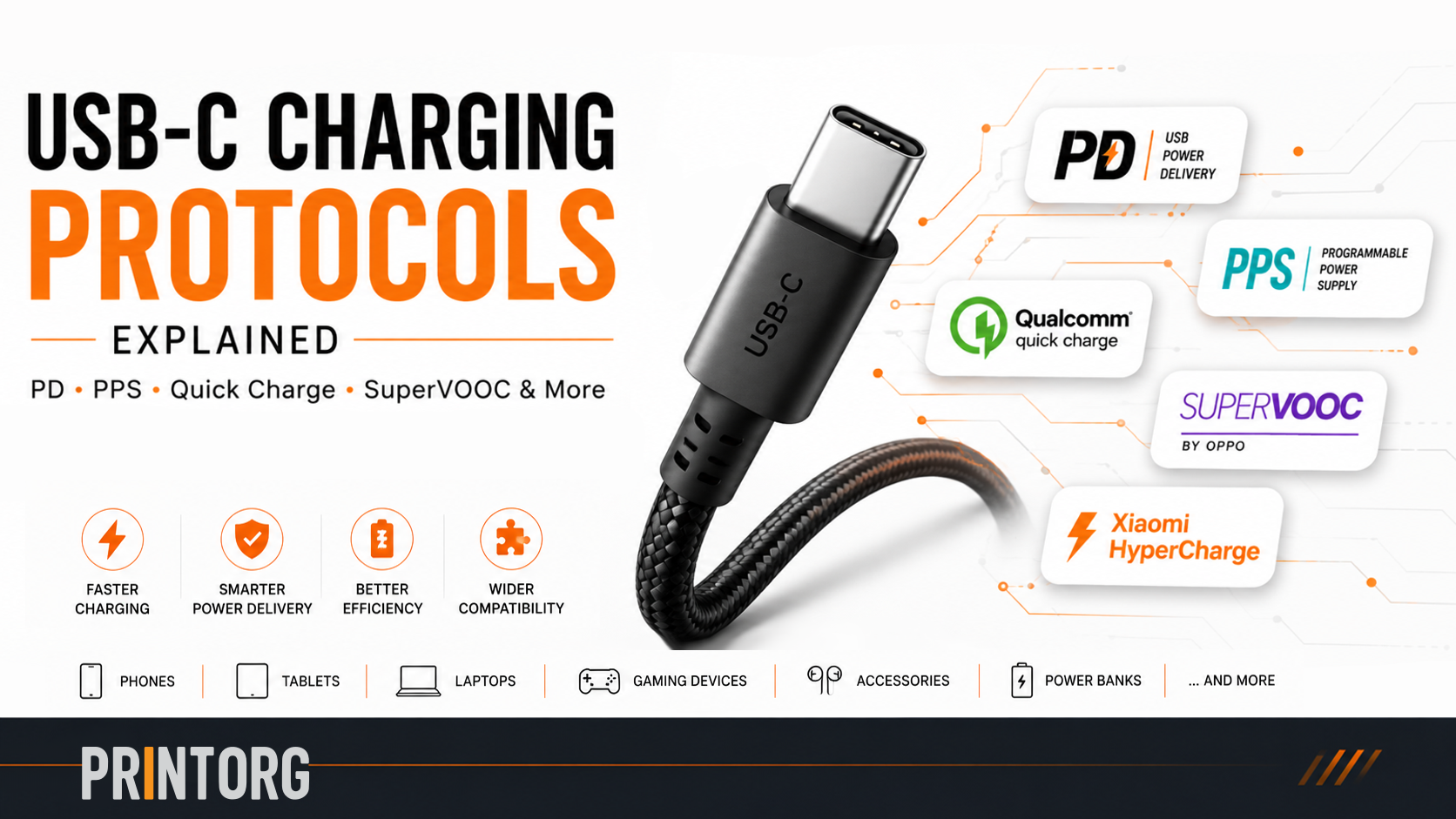
- The charging protocol (USB Power Delivery, PPS, Quick Charge, SuperVOOC, etc.).
- The charger’s capabilities.
- The USB-C cable being used.
If any one of these components becomes a bottleneck, charging speed will be reduced.
Apple iPhone Charging Speeds
| Model | Maximum Wired Charging |
|---|---|
| iPhone 16e | 20W |
| iPhone 16 | 27W |
| iPhone 16 Plus | 27W |
| iPhone 16 Pro | 27W |
| iPhone 16 Pro Max | 30W |
Apple prioritises battery longevity and thermal management over extreme charging speeds.
Samsung Galaxy Charging Speeds
| Model | Maximum Wired Charging |
|---|---|
| Galaxy A16 | 25W |
| Galaxy A26 | 25W |
| Galaxy A36 | 45W |
| Galaxy A56 | 45W |
| Galaxy S25 | 25W |
| Galaxy S25+ | 45W |
| Galaxy S25 Ultra | 45W |
Samsung uses USB Power Delivery with PPS for its fastest charging modes.
Google Pixel Charging Speeds
| Model | Maximum Wired Charging |
|---|---|
| Pixel 9a | 23W |
| Pixel 9 | 27W |
| Pixel 9 Pro | 27W |
| Pixel 9 Pro XL | 37W |
Google focuses more on battery health than headline charging numbers.
OnePlus Charging Speeds
| Model | Maximum Wired Charging |
|---|---|
| OnePlus Nord 4 | 100W |
| OnePlus 13R | 100W |
| OnePlus 13 | 100W |
OnePlus remains one of the fastest charging brands available in Europe.
Xiaomi Charging Speeds
| Model | Maximum Wired Charging |
|---|---|
| Xiaomi 15 | 90W |
| Xiaomi 15 Ultra | 90W |
| Redmi Note 14 Pro+ | 120W |
Xiaomi continues to push charging technology with some of the highest charging speeds available to consumers.
Nothing Phone Charging Speeds
| Model | Maximum Wired Charging |
|---|---|
| Nothing Phone (3a) | 50W |
| Nothing Phone (3a Pro) | 50W |
| Nothing Phone (3) | 65W |
Motorola Charging Speeds
| Model | Maximum Wired Charging |
|---|---|
| Edge 60 Fusion | 68W |
| Edge 60 Pro | 90W |
| Razr 60 Ultra | 68W |
OPPO Charging Speeds
| Model | Maximum Wired Charging |
|---|---|
| Reno13 Pro | 80W |
| Find X8 Pro | 80W |
Realme Charging Speeds
| Model | Maximum Wired Charging |
|---|---|
| Realme GT 7 | 120W |
| Realme GT 7T | 120W |
Which Phones Charge the Fastest?
As of 2026, some of the fastest mainstream smartphones available in Europe are:
- Realme GT 7 – 120W
- Realme GT 7T – 120W
- Redmi Note 14 Pro+ – 120W
- OnePlus 13 – 100W
- OnePlus 13R – 100W
- OnePlus Nord 4 – 100W
- Xiaomi 15 Ultra – 90W
- Motorola Edge 60 Pro – 90W
Bigger Numbers Are Not Always Better
Fast charging is convenient, but charging speed is only one part of the equation.
Manufacturers must also consider:
- Battery lifespan
- Heat generation
- Charging efficiency
- Device safety
This is why some phones prioritise battery longevity over achieving the highest possible charging speed.
Final Thoughts
The highest charging speed is not always the best charging speed.
A 100W charger does not automatically mean your phone will charge at 100W.
The charger, phone, charging protocol and USB-C cable all need to work together to achieve the best possible performance.
When choosing a charger or USB-C cable, always verify that it supports your device’s required charging standard and power level.
Need help choosing the right charger or cable? Printorg regularly tests USB-C accessories and publishes practical guides to help consumers make informed decisions.
“USB-C Charging Protocols Explained: PD, PPS, Quick Charge, SuperVOOC and More”